Why Siena Is One of Italy's Most Romantic Wedding Destinations
Siena occupies a singular place in the Italian imagination. While Florence dazzles with Renaissance grandeur and Rome overwhelms with imperial scale, Siena offers something rarer — a medieval city so perfectly preserved that walking its narrow streets feels less like visiting a monument and more like stepping into a living, breathing work of art. The shell-shaped Piazza del Campo, the soaring striped marble of the Duomo, and the warm ochre palette that gave the world the colour "burnt sienna" create a setting of extraordinary beauty and intimacy.
But Siena's appeal as a wedding destination extends far beyond the city walls. The province of Siena encompasses some of Tuscany's most celebrated landscapes: the Val d'Orcia — a UNESCO World Heritage Site of rolling clay hills, lone cypress trees, and medieval hilltop towns — the Chianti Classico vineyards stretching north toward Florence, the Crete Senesi badlands with their otherworldly eroded clay formations, and the thermal springs of Bagno Vignoni and Rapolano. This diversity of landscape means couples marrying in the Siena area can choose from an exceptional range of settings, all within 30–60 minutes of the city centre.
Siena hosts approximately 1,500 destination weddings each year, with the season running from late April through early November. The city and its surrounding countryside have developed a mature wedding industry — experienced planners, photographers, caterers, and florists who understand the specific needs of international couples. June and September are the peak months, when the Tuscan light reaches its most photogenic and the temperatures are ideal for outdoor celebrations.
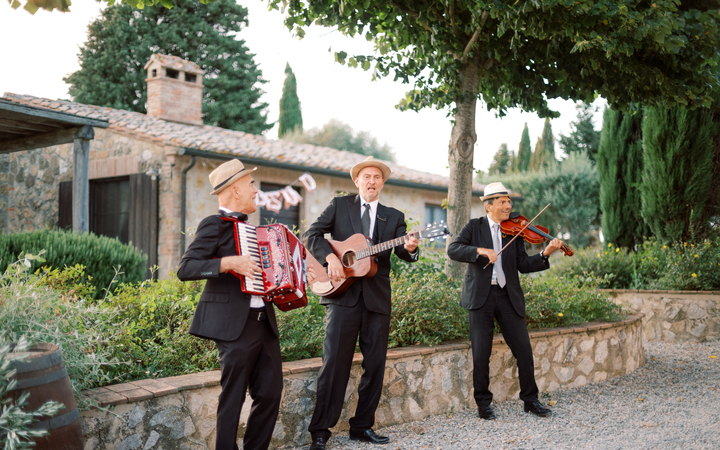
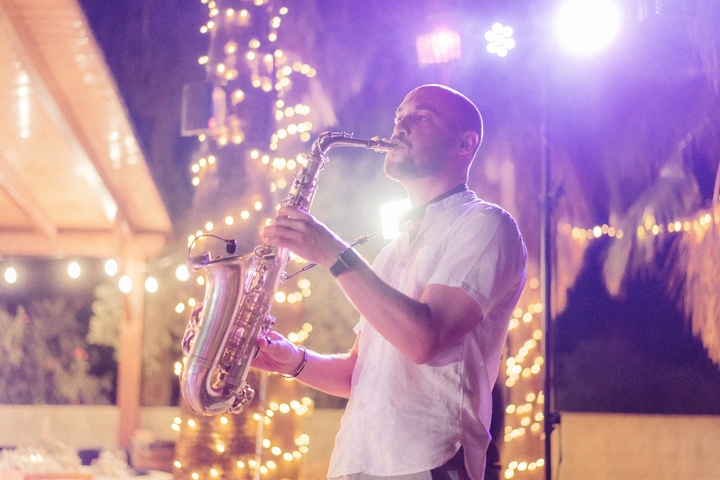
What makes Siena particularly special for live music is the acoustic intimacy of its venues. Unlike the sprawling estates of the Chianti hills or the grand palazzi of Florence, many Sienese wedding settings are human-scaled — medieval courtyards, intimate cloister gardens, converted farmhouse terraces — where a well-chosen band connects with every guest in the room. Music here feels personal, not performative.
Popular Venues & Settings for Siena Weddings
Medieval Estates in the Val d'Orcia
The Val d'Orcia south of Siena is the landscape you see on every Tuscan calendar and wine label: undulating hills, golden fields, solitary cypresses, and fortified medieval towns perched on ridges. Towns like Pienza, Montalcino, San Quirico d'Orcia, and Monticchiello offer restored estate venues that sit within this UNESCO-listed panorama. Receptions take place on terraces with views that stretch for kilometres, while ceremonies unfold in private chapels or under centuries-old oak trees.
Band considerations: Val d'Orcia venues are remote — beautifully, gloriously remote. This means two things for bands: first, sound carries across the empty landscape without restriction, and noise complaints are virtually non-existent. Second, logistics require serious advance planning. Access roads are often unpaved strade bianche (white gravel roads), some barely wide enough for a single vehicle. Bands need GPS coordinates, not postal addresses, and should plan to arrive in daylight. Power supply is frequently limited to domestic capacity (16A single-phase), making a generator essential for full band setups. Cell signal can be unreliable, so all communication and setup details should be confirmed well in advance.
Chianti Classico Villas & Farmhouses
Between Siena and Florence lies the Chianti Classico zone — a landscape of vineyards, olive groves, and restored stone farmhouses that has been the backdrop for Tuscan destination weddings for decades. Towns like Castellina in Chianti, Radda in Chianti, Gaiole in Chianti, and Castelnuovo Berardenga are all within the Siena province and offer a concentration of wedding venues — from intimate converted poderi (farmsteads) to grand wine estate villas.
Band considerations: Chianti properties vary widely in their suitability for live music. The best wedding venues have purpose-built outdoor entertainment areas with level ground, power connections, and even permanent PA mounting points. Others are charming but challenging — uneven surfaces, limited electricity, and pergola roofs that obstruct sound. Key questions: Is there a flat area of at least 4m x 3m for the band? What's the distance from the parking area to the performance space? (Chianti stone farmhouses often involve carrying equipment up flights of external stone steps.) Is there a covered Plan B space in case of rain? Many Chianti venues have noise curfews set by the local comune — midnight is standard, with some allowing 1am.
Siena City Centre Venues
Siena's historic centre offers a small but exceptional selection of wedding venues: centuries-old palazzi with frescoed reception rooms, boutique hotels with rooftop terraces overlooking the Duomo, and private cortili (courtyards) tucked behind medieval façades. Civil ceremonies can be held at the Palazzo Pubblico on Piazza del Campo — one of the most spectacular civil ceremony settings in all of Italy.
Band considerations: City-centre venues come with significant logistical constraints. Siena's centro storico is a pedestrian zone — vehicle access for equipment load-in requires permits and is typically restricted to early morning hours (before 9am) or specific time windows. Equipment must often be carried through narrow streets and up staircases. Volume restrictions in the city centre are stricter than in the countryside, with noise curfews as early as 10:30pm in some locations. Acoustic and semi-acoustic setups (unamplified vocals, acoustic guitar, double bass, brushed drums) work brilliantly in Siena's intimate stone courtyards, where the natural acoustics project beautifully without amplification.
Castello & Fortezza Venues
The Siena province is studded with castles and fortified estates, from the imposing Fortezza Medicea in Siena itself to the romantic castles of the Chianti hills and the medieval strongholds of the Crete Senesi. These venues offer dramatic settings — towers, battlements, barrel-vaulted cellars, and panoramic terraces — for celebrations of 80 to 250 guests.
Band considerations: Castle acoustics are extreme. Thick stone walls, vaulted ceilings, and narrow rooms amplify and distort sound in unpredictable ways. An experienced band or sound engineer who has worked in medieval Italian spaces is genuinely valuable here. Lower-register instruments (bass guitar, kick drum) can build up overpowering resonance in stone-walled rooms, while high frequencies get absorbed. Smart bands adapt: reducing low-end, using smaller amplifiers, favouring acoustic instruments during dinner, and saving the full-volume party set for outdoor terraces or larger halls. Load-in at castle venues often involves cobblestone courtyards, gates, and portcullis-width doorways — advance measurements and site visits are strongly recommended.
Monastery & Abbey Venues
The Siena area is home to several former monasteries and abbeys — including the magnificent Abbazia di Monte Oliveto Maggiore, the Abbazia di Sant'Antimo near Montalcino, and smaller restored monastic properties — that host wedding receptions and sometimes civil ceremonies in cloisters, refectories, and gardens of sublime beauty.
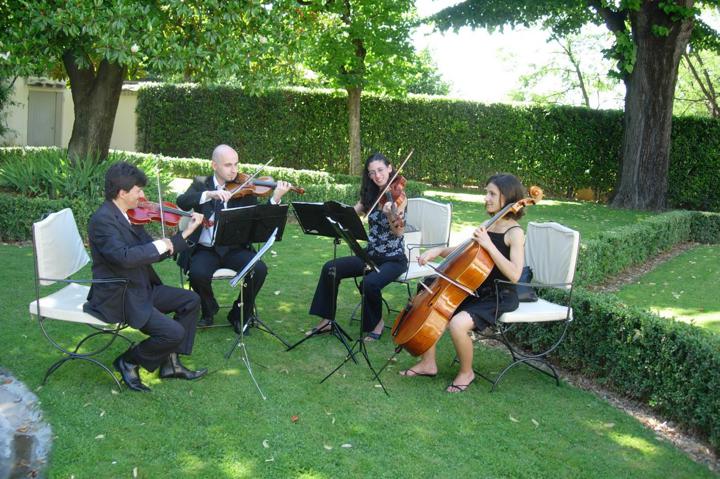
Band considerations: Monastic venues carry an atmosphere of contemplation and tranquility that the music should respect. Acoustic ensembles — string quartets, classical guitarists, vocal groups — are perfect for ceremonies and dinner in these spaces. Full band setups for dancing are typically located in a separate courtyard or garden area, maintaining the distinction between the sacred character of the buildings and the joyful celebration. Cloistered courtyards have remarkable acoustics — sound circulates within the enclosed square, creating a natural amplification that means even quiet instruments project clearly. Check whether the venue is still partially in use as a religious house, as this will affect noise policies and scheduling.